
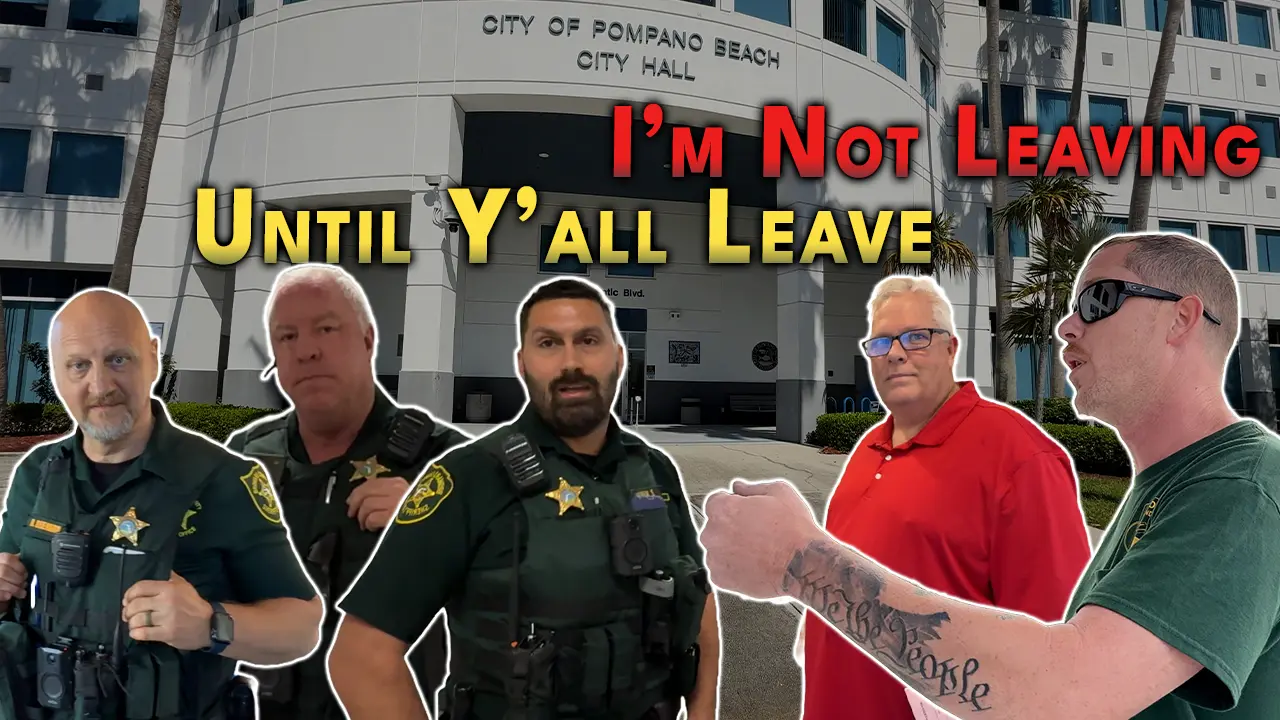
Cowboy Justice and a 3 Hour Police Standoff at Pompano Beach City Hall
SUPPORT MY CHANNEL BY BECOMING A MEMBER TO SEE THIS VIDEO EARLY!
Location Details
Date of Audit: 10/30/2025
Physical Address: 100 Atlantic Blvd, Pompano Beach, FL 33060
Phone: (954) 786-4600
Website: https://pompanobeachfl.gov/
City of Pompano Beach Social Media Accounts
Broward Sheriff's Office Social Media Accounts
By the time Part 2 begins, the absurdity has already settled in.
No crime has been committed.
No laws have been broken.
No one has been detained, trespassed, or cited.
And yet, police are still there.
Not because of an investigation.
Not because of public safety.
But because someone, somewhere, might feel uncomfortable again and call 911.
This is the moment where the encounter at Pompano Beach City Hall fully crosses the line from strange to unsettling. What started as one man’s discomfort has now evolved into an extended police presence with no legal purpose, no end in sight, and no clear authority behind it.
Welcome to the second half of the standoff.
When Police Say the Quiet Part Out Loud
At a certain point, the deputies stop dancing around the explanation and say it plainly.
They are not there to enforce the law.
They are there to “mitigate further calls.”
That admission changes everything.
Up until now, the police presence could be framed as caution. As prudence. As officers taking a moment to make sure everyone is safe and informed. But once they acknowledge that no enforcement action is occurring and that the sole purpose of remaining is to prevent complaints, the entire dynamic shifts.
This is no longer about law.
It’s about managing feelings.
That distinction matters more than people realize.
Police authority is derived from statutes, ordinances, and constitutional limits. It is not derived from the possibility that someone might call dispatch because they don’t like what they’re seeing. When officers remain in place solely to prevent annoyance, they are no longer enforcing rules. They are acting as a buffer between lawful behavior and public discomfort.
That’s a dangerous precedent.
The New Standard: “Someone Might Call Again”
Think about what that standard implies.
If police stay because someone might call again, then the threshold for police involvement drops to nearly zero. Any lawful activity that upsets someone becomes justification for prolonged enforcement presence, even when no enforcement is happening.
It creates a feedback loop.
Someone feels uncomfortable.
They call 911.
Police respond.
Police stay to prevent more calls.
Their presence reinforces the idea that something is wrong.
More people feel validated in calling.
The cycle continues.
At no point does the legality of the behavior change. But the pressure to stop doing it increases with every passing minute.
This is how rights get chilled without ever being revoked.
The Long Middle: Time as a Tactic
As the minutes stretch into hours, something subtle but important happens. Time itself becomes the tactic.
There are no orders. No threats. No escalation from law enforcement. Just waiting.
Waiting is powerful.
Most people don’t have the luxury of spending hours in a government building doing nothing. They have jobs. Appointments. Families. Responsibilities. When police choose to “wait it out,” they’re betting on attrition. They’re betting that eventually the person exercising their rights will decide it’s not worth the inconvenience.
That bet usually pays off.
It’s quiet. It’s clean. And it leaves no obvious civil rights violation behind.
But it’s still pressure.
Shift Change Comes and Goes
At some point, something remarkable happens.
Shift change arrives.
The officers who initially responded begin to rotate out. New faces appear. The standoff doesn’t end. It simply refreshes.
This is the moment where the situation becomes impossible to defend as anything resembling normal police work. An entire shift cycle has come and gone, and the only justification for continued presence is still the same: preventing complaints about lawful activity.
No crime.
No suspect.
No enforcement.
Just babysitting discomfort.
For taxpayers, this should be infuriating. For civil libertarians, it should be alarming. For anyone who believes police resources should be used wisely, it’s hard to justify.
And yet, the standoff continues.
City of Pompano Beach Employee Details
Name: Allied Security Officer Gianna Fiskey
Title: City Contractor
Name: Jay Olsen
Email Address: Jay.olsen@copbfl.com.
Work Phone: (954) 545-7793
Title: Building Safety Inspector
Broward Sheriff's Office Employee Details
Name: Z Kerin #19089
Email Address: waiting on public record
Title: Deputy Sheriff
Supervisor: waiting on public record
Supervisor Email: waiting on public record
Name: D Bejenaru #16652
Email Address: waiting on public record
Title: Deputy Sheriff
Supervisor: waiting on public record
Supervisor Email: waiting on public record
Name: Jenkins #14328
Email Address: waiting on public record
Title: Seargeant
Supervisor: waiting on public record
Supervisor Email: waiting on public record
Enter the Peanut Gallery
As often happens in these situations, someone who has no authority, no official role, and no legal standing decides to insert themselves.
This time, it’s a man associated with Anthony Lock & Safe.
He is not law enforcement.
He is not a city employee.
He has no stake in the situation beyond personal opinion.
But he is confident. Very confident.
He positions himself as a voice of reason, though what follows is anything but reasonable. He begins to argue that filming in public creates danger. That police have to stay. That in today’s world, people are unpredictable, violent, and unstable.
This is a familiar argument.
It’s the logic of fear. The idea that because something could go wrong, it must be stopped. That rights are optional luxuries, acceptable only when nothing bad ever happens.
And then he says it.
“Good Ol’ Cowboy Justice”
The phrase lands like a brick.
“Good ol’ cowboy justice.”
He says it casually. Comfortably. As if he’s describing a nostalgic solution to a modern inconvenience. According to him, if officers were allowed to rough people up a bit, situations like this would never happen.
No cameras.
No questions.
No discomfort.
Just force.
The irony is staggering.
In a conversation supposedly about safety, the proposed solution is violence. In a discussion framed around law and order, the suggestion is lawlessness. In a government building, the call is for vigilante-style enforcement.
And he says it out loud. On camera. In public.
This is the moment where the mask slips.
What “Cowboy Justice” Really Means
“Cowboy justice” is a euphemism. It always has been.
It’s the idea that rules are inconvenient. That due process is slow. That rights get in the way of efficiency. It’s the belief that problems should be solved with fists instead of law, intimidation instead of dialogue.
When someone advocates for it, they are not expressing concern for public safety. They are expressing frustration that they cannot control the situation.
They want outcomes without constraints.
And that worldview is fundamentally incompatible with constitutional rights.
The Silence That Speaks Volumes
What’s almost as telling as the comment itself is what happens afterward.
No one endorses the statement openly.
No one corrects it forcefully.
No one shuts it down immediately.
It hangs in the air.
That silence matters.
When extreme rhetoric goes unchallenged in spaces of authority, it gains legitimacy. It becomes part of the conversation instead of being dismissed as unacceptable.
In that moment, the line between lawful authority and mob mentality feels uncomfortably thin.
This Was Never About Safety
By now, the truth is impossible to ignore.
This was never about safety.
It was never about crime.
It wasn’t even really about filming.
It was about control.
It was about the belief that if something makes you uncomfortable, someone else should be forced to stop doing it. And if the law doesn’t provide that authority, then maybe violence should.
That belief is more common than people like to admit.
Three Hours Later
By the time the encounter finally winds down, more than three hours have passed.
Multiple officers have rotated through. Supervisors have appeared and disappeared. Conversations have looped back on themselves.
And still, no crime has been identified.
The standoff doesn’t end with enforcement. It ends with exhaustion. With practicality. With the quiet realization that nothing is going to change.
That’s not a victory for anyone.
Why This Matters Far Beyond One Building
It would be easy to dismiss this as a weird day. A collection of odd personalities colliding at the wrong time. But that would miss the bigger picture.
What happened here reflects a growing cultural shift. A willingness to treat discomfort as authority. A readiness to call police over lawful behavior. A comfort with the idea that force is an acceptable solution when rights become inconvenient.
That should worry everyone.
Today it’s a camera in City Hall. Tomorrow it’s a protest sign. A journalist. A citizen asking the wrong question at the wrong meeting.
Rights don’t vanish overnight. They erode when they’re treated as optional.
Cameras Matter Because People Forget
This entire encounter exists because a camera was present.
Without it, the narrative would be different. Cleaner. Simpler. Someone would have felt uncomfortable. Police would have “handled it.” And no one would question how or why.
Cameras don’t create problems. They reveal them.
They document how power is exercised. How authority responds to challenge. And how quickly principles bend under social pressure.
That’s why they matter.
Final Thoughts
The three-hour standoff at Pompano Beach City Hall didn’t expose a crime. It exposed a mindset.
A mindset where discomfort demands enforcement. Where police presence substitutes for legal authority. Where “cowboy justice” is floated as a solution to lawful behavior.
That’s not a future anyone should want.
If nothing else, this encounter serves as a reminder: rights only exist when people insist on exercising them, even when it’s inconvenient, awkward, or uncomfortable.
Especially then.
👉 If you missed Part 1, start there:
Richard’s Discomfort Triggered Multiple 911 Calls… And a 3-Hour Police Standoff
Disclaimer
The people appearing in my videos are in public spaces where there are no reasonable expectations of privacy. Recording in public is protected by the First Amendment of the United States Constitution. This video is for entertainment and educational purposes only. The legal topics covered on GCNN are designed to be educational and informative. They should never serve as legal advice under any circumstances. The content of this video is in no way intended to provoke, incite, or shock the viewer. This video was created to educate citizens about constitutionally protected activities, law, civilian rights, and emphasize the importance of exorcising your rights in a peaceful manner.
It's Free To Support GCNN By Sharing This Post To Your
One thought on “Cowboy Justice and a 3 Hour Police Standoff at Pompano Beach City Hall”
Comments are closed.