
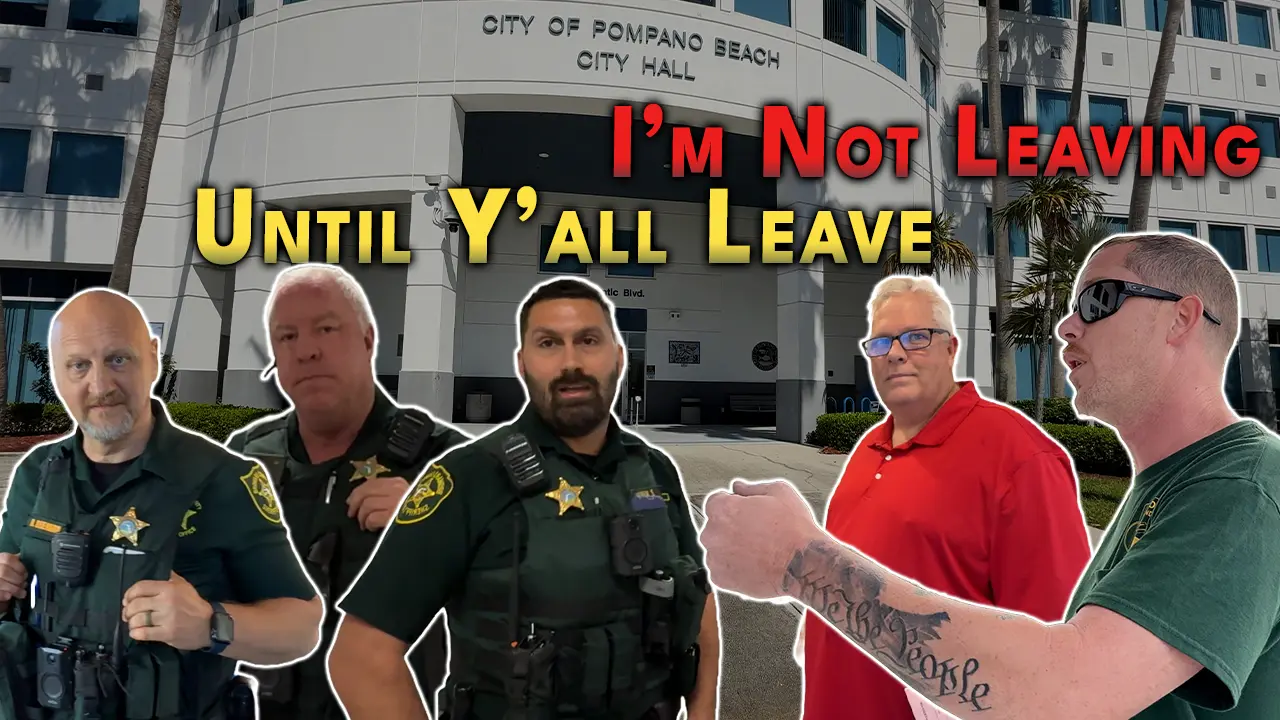
Richard’s Discomfort Triggered Multiple 911 Calls… And a 3-Hour Police Standoff
SUPPORT MY CHANNEL BY BECOMING A MEMBER TO SEE THIS VIDEO EARLY!
Richard's Call To WHINE-1-1
Allied Security Officer Gianna Fiskey's Call To WHINE-1-1
Location Details
Date of Audit: 10/30/2025
Physical Address: 100 Atlantic Blvd, Pompano Beach, FL 33060
Phone: (954) 786-4600
Website: https://pompanobeachfl.gov/
City of Pompano Beach Social Media Accounts
Broward Sheriff's Office Social Media Accounts
Walking into a public building with a camera
should be one of the least remarkable things a person can do. People walk into City Hall every day holding phones, documents, coffee cups, backpacks, strollers, and half-remembered complaints about parking tickets. Cameras are already everywhere. Ceiling-mounted. Desk-mounted. Body-worn. Ringed around the building like electronic barnacles.
And yet, every once in a while, one handheld camera manages to short-circuit the entire system.
That’s what happened inside Pompano Beach City Hall.
I didn’t arrive looking for a confrontation. There was no script, no target, no intention to push anyone’s buttons. The plan was simple and painfully boring: record in a publicly accessible government building, observe the environment, and document how public employees and visitors react to lawful activity when it’s done openly and calmly.
What I got instead was a masterclass in how personal discomfort can snowball into police involvement, institutional confusion, and the opening chapter of a three-hour standoff that never should have existed in the first place.
This is Part 1 of that story.
When Feelings Try to Become Law
The encounter began the way many of these encounters begin: not with a statute, not with a policy, and not with a violation, but with a feeling.
Richard didn’t like being filmed.
That was the entirety of the problem.
No accusation of interference.
No claim that I was disrupting city business.
No suggestion that I had entered a restricted area.
Just discomfort.
And to be clear, discomfort itself isn’t a crime. Nobody is obligated to enjoy being on camera. People are allowed to feel awkward, annoyed, or irritated. That’s all perfectly human.
The issue arises when someone decides that their discomfort should carry legal authority.
Richard demanded that I stop filming. He asserted that I had no right to record him. He spoke with the confidence of someone who was absolutely certain the law was on his side, despite not citing any actual law.
This is a recurring theme in public encounters like this one. People often mistake confidence for correctness. They speak in absolutes. They issue commands. They invoke vague concepts like “privacy” without understanding how privacy actually works in public spaces.
Public buildings don’t operate on feelings. They operate on rules. And in publicly accessible areas of government buildings, there is no reasonable expectation of privacy. That principle has been upheld repeatedly, in courts, in policy, and in practice.
You can dislike it. You can complain about it. You can avoid it by stepping away.
What you cannot do is unilaterally revoke someone else’s rights because you feel uncomfortable.
Escalation by Phone Call
Instead of disengaging, Richard escalated.
Rather than walking away or asking a city employee for clarification, he reached for the modern solution to discomfort: calling the police.
This is where things shift from mildly awkward to institutionally problematic.
Calling 911 is supposed to be reserved for emergencies. Situations involving immediate danger, crimes in progress, or urgent threats to life or property. It is not meant to function as a customer service line for people who don’t like what someone else is doing.
Yet increasingly, that’s exactly how it’s used.
In this case, there was no crime to report. Nothing unlawful was occurring. But the call went in anyway. And once it does, a process begins that’s difficult to reverse.
Dispatchers don’t get to ignore calls. Officers are required to respond. Resources are allocated. The presence of law enforcement becomes inevitable, regardless of whether the underlying complaint has merit.
This is how lawful behavior gets reframed as suspicious. Not because it is, but because someone says it is.
City of Pompano Beach Employee Details
Name: Allied Security Officer Gianna Fiskey
Title: City Contractor
Name: Jay Olsen
Email Address: Jay.olsen@copbfl.com.
Work Phone: (954) 545-7793
Title: Building Safety Inspector
Broward Sheriff's Office Employee Details
Name: Z Kerin #19089
Email Address: waiting on public record
Title: Deputy Sheriff
Supervisor: waiting on public record
Supervisor Email: waiting on public record
Name: D Bejenaru #16652
Email Address: waiting on public record
Title: Deputy Sheriff
Supervisor: waiting on public record
Supervisor Email: waiting on public record
Name: Jenkins #14328
Email Address: waiting on public record
Title: Seargeant
Supervisor: waiting on public record
Supervisor Email: waiting on public record
The Weaponization of 911
This is worth pausing on, because it’s bigger than this one encounter.
Calling 911 over lawful behavior is not just an overreaction. It’s a misuse of a system designed for emergencies. When people learn that they can summon armed officers simply by expressing discomfort, a dangerous incentive structure forms.
The message becomes clear: if you don’t like what someone is doing, you don’t need to engage, disengage, or educate yourself. You just need to call.
That behavior carries consequences.
It diverts police resources away from real emergencies. It increases unnecessary police-citizen encounters. And it trains the public to believe that law enforcement exists to resolve personal unease rather than enforce laws.
Even worse, it shifts accountability. Once police arrive, the narrative often becomes about “what officers decided” instead of whether the call should have happened at all.
The original misuse disappears into the background.
That’s exactly what happened here.
The Police Arrive and the Narrative Shifts
When deputies arrived at City Hall, the situation changed immediately.
They listened. They observed. They assessed the scene. And to their credit, they recognized something important very quickly: no crime was taking place.
No disorderly conduct.
No trespassing.
No obstruction.
No interference with city operations.
Just a person with a camera in a public building.
At that point, the logical resolution should have been straightforward. A brief explanation. Some education. Possibly a reassurance to the complaining party that public spaces are, in fact, public.
Instead, something more subtle happened.
The deputies acknowledged that filming was legal… and then decided to stay anyway.
Not to enforce the law.
Not to issue directives.
Not to investigate a crime.
But to “mitigate further calls.”
That phrase matters.
They weren’t staying because I had done anything wrong. They were staying because someone else might call again.
This is where the situation quietly crossed from law enforcement into something else entirely.
When Presence Becomes Pressure
No one ordered me to leave.
No one threatened arrest.
No one issued a trespass warning.
On paper, my rights were fully intact.
In practice, however, the dynamic had changed.
A prolonged police presence sends a message, even when it’s polite and professional. It suggests that something is wrong. It creates an atmosphere of scrutiny. It applies pressure without ever issuing a command.
This is how rights often erode in the real world. Not through overt force, but through inconvenience and fatigue.
Security staff began floating procedural suggestions. ID requests were mentioned casually. The idea of being escorted through hallways came up, despite the fact that members of the public normally move freely through those same spaces every day.
Nothing aggressive. Nothing explicit.
Just enough friction to make a reasonable person consider leaving.
And that’s the point.
The Chilling Effect of “Voluntary” Compliance
There’s a phrase often used in civil liberties discussions: chilling effect.
It refers to the idea that people may stop exercising their rights not because those rights are explicitly taken away, but because exercising them becomes inconvenient, uncomfortable, or socially punished.
That’s what was happening here.
No one needed to issue an unlawful order. No one needed to threaten arrest. All that was required was the sustained presence of authority and the implication that things would be easier if I just left.
This type of pressure is difficult to document and even harder to challenge, precisely because it exists in the gray space between legality and coercion.
Everything remains technically lawful. Rights remain technically intact. And yet, the outcome often mirrors enforcement.
That should concern anyone who values constitutional protections.
The Waiting Game
As time passed, it became clear that no one was in a hurry to resolve the situation.
The deputies weren’t leaving.
And neither was I.
Not out of stubbornness, but out of principle.
Leaving under those conditions creates a false narrative. It looks like enforcement where none occurred. It suggests that police authority successfully removed someone for lawful behavior, even when that authority didn’t exist.
So the standoff began.
No raised voices.
No ultimatums.
No dramatic confrontations.
Just time.
Minutes turned into an hour.
An hour turned into more.
And all of it stemmed from one simple fact: someone felt uncomfortable.
Why City Hall Matters
This didn’t happen in a random strip mall or a private office building. It happened in City Hall.
That matters.
City Hall is the symbolic center of local government. It’s where citizens pay fees, file complaints, attend meetings, and interact with the institutions that govern their daily lives.
If constitutional rights are treated as optional there, where exactly are they supposed to be secure?
Government buildings should be the last place where feelings override law. They should model transparency, restraint, and respect for civil liberties. Instead, what unfolded here suggested the opposite: that discomfort, when expressed loudly enough, can bend institutions away from their principles.
That’s not a good precedent.
This Is Only the Beginning
By the time Part 1 ends, the stage is set.
Police are still present.
The hours are beginning to stack up.
And the justification for staying has shifted entirely away from the law.
What follows in Part 2 is where the situation escalates from quietly absurd to openly alarming. A new voice enters the scene. Rhetoric hardens. And the phrase “cowboy justice” is said out loud, on camera, inside a government building.
That’s where this story goes next.
👉 Read Part 2 here:
Cowboy Justice and a 3 Hour Police Standoff at Pompano Beach City Hall
Disclaimer
The people appearing in my videos are in public spaces where there are no reasonable expectations of privacy. Recording in public is protected by the First Amendment of the United States Constitution. This video is for entertainment and educational purposes only. The legal topics covered on GCNN are designed to be educational and informative. They should never serve as legal advice under any circumstances. The content of this video is in no way intended to provoke, incite, or shock the viewer. This video was created to educate citizens about constitutionally protected activities, law, civilian rights, and emphasize the importance of exorcising your rights in a peaceful manner.
It's Free To Support GCNN By Sharing This Post To Your
One thought on “Richard’s Discomfort Triggered Multiple 911 Calls… And a 3-Hour Police Standoff”
Comments are closed.