
I Wasn’t Planning to Film… Then This Happened at the Courthouse
SUPPORT MY CHANNEL BY BECOMING A MEMBER TO SEE THIS VIDEO EARLY!
Location Details
PBC Social Media Accounts
Date of Filming: 02/02/2026
Location 1: 205 N Dixie Hwy, West Palm Beach, FL 33401
Phone: (561) 355-2996
Website: https://mypalmbeachclerk.com
An Unexpected Turn at the Palm Beach County Courthouse
I wasn’t planning to film that day. I was inside the Palm Beach County Courthouse in West Palm Beach, Florida handling a separate matter. It wasn’t an audit. It wasn’t a setup. I didn’t show up looking for confrontation. I was there for personal business.
On my way out of the building, though, something told me to turn the camera on.
If you’ve followed this channel for any amount of time, you know that instinct. You feel it when you’re in a government building and there’s something worth documenting. Maybe it’s the layout. Maybe it’s the signage. Maybe it’s the security checkpoint. Whatever it is, you know it’s better to record than to assume everything will be smooth.
So I did. I began filming the security checkpoint as I exited the courthouse. It didn’t take long before someone noticed.
When the Focus Shifted from Law to Tone
I was standing across the lobby filming in the direction of the security checkpoint when one of the security personnel noticed the camera and asked if I was recording her. That question is common in public buildings. Even when filming is lawful, it can make people uncomfortable. I responded that it wasn’t her business.
From there, the focus of the conversation shifted. The deputy who joined the interaction didn’t argue that filming was illegal. Instead, the discussion centered on my tone — whether I was being rude, and whether that somehow changed the situation. Is rudeness illegal? That question became the real issue.
Escalation — And De-Escalation
The exchange didn’t spiral into arrest or detention. There were no handcuffs. No trespass warning. No removal from the building. But there was tension. Anyone who has stood in a government building holding a camera understands that tension. The moment when authority figures decide how they’re going to handle you. The moment when you decide how you’re going to handle them.
Eventually, a supervising sergeant stepped in. This part matters. The sergeant handled the situation professionally. Calmly. Directly. There was no dramatic showdown. No constitutional lecture battle. Just clarification.
And here’s the part that matters most: I apologized for my tone.
That moment is easy to overlook. It’s not flashy. It won’t generate outrage clips. But it’s real. Rights matter. So does accountability. If I cross the line socially while remaining within the law legally, I can still own that.
The law was never truly the issue inside that courthouse. The tension was. That distinction is important.
Walking Outside — Into a Traditional Public Forum
After leaving the building, I stepped onto the courthouse steps.
For those unfamiliar with the terminology, courthouse steps fall into what’s known as a traditional public forum. That category includes sidewalks, parks, and public plazas. It carries the highest level of First Amendment protection.
If there had been any ambiguity inside the building, there was none outside.
So I kept filming.
People were coming and going. Attorneys. Defendants. Families. Staff. Regular citizens handling everyday legal matters. The courthouse doesn’t stop being a public space just because emotions run high inside it.
And that’s when the tone of the video changed.
Inside, the conversation centered on authority and tone. Outside, it shifted to public perception.
Some people walked by without concern. Others looked twice. A few stopped and asked questions. The camera didn’t change the law, but it changed the atmosphere.
That contrast matters.
A Bride on the Courthouse Steps
Earlier, as I walked toward the entrance, I noticed a bride and groom taking photos in front of the courthouse. It’s a strange contrast when you think about it. Inside, people deal with charges, hearings, disputes, and judgments. Outside, someone is starting a marriage.
When I stepped back onto the public steps and resumed filming, I saw her again.
She noticed the camera almost immediately. Instead of objecting, instead of questioning, she turned and walked toward me.
For the first time on this channel, someone who realized they were being recorded asked if I would take their picture.
I didn’t capture the exact moment she made the request. The camera was rolling, but not on her words. Still, the meaning was clear. She trusted the person holding the lens.
How do you say no to that?
So I took a few photos. The bride and groom smiled. They adjusted their posture. They laughed. For a moment, the courthouse wasn’t a place of tension or authority. It was simply a backdrop to a milestone.
The contrast was almost cinematic.
Inside, the conversation revolved around tone and legality. Outside, the same camera that raised concern became a tool to preserve a memory.
It’s a reminder that the lens itself isn’t the issue. Perception is.
When the Conversation Turned Public
Not everyone outside saw the camera as harmless.
As I continued filming on the courthouse steps, one man took issue with what I was doing. The questions came quickly.
Why are you filming?
What gives you the right?
Why are you recording people coming in and out?
The tone shifted almost immediately. Inside the building, the discussion centered on authority and professionalism. Outside, it became personal.
There’s something about a camera that triggers instinctive reactions. For some, it represents transparency. For others, intrusion.
From his perspective, filming near a courthouse likely felt invasive. From mine, I was standing in a traditional public forum, documenting activity visible to anyone walking by.
The law was clear. The discomfort was not.
The volume rose. Assumptions were made. The idea that recording in public must somehow be illegal surfaced again. It’s a common belief — and an incorrect one.
Being in public means being observable. That doesn’t mean people have to like it. But it does mean the activity itself is lawful.
The exchange outside felt less procedural than the one inside. There was no badge, no uniform, no chain of command. Just two people standing on public steps, operating from very different understandings of what “privacy” means in a public space.
And that’s where much of the tension in modern public filming exists — not in the law, but in perception.
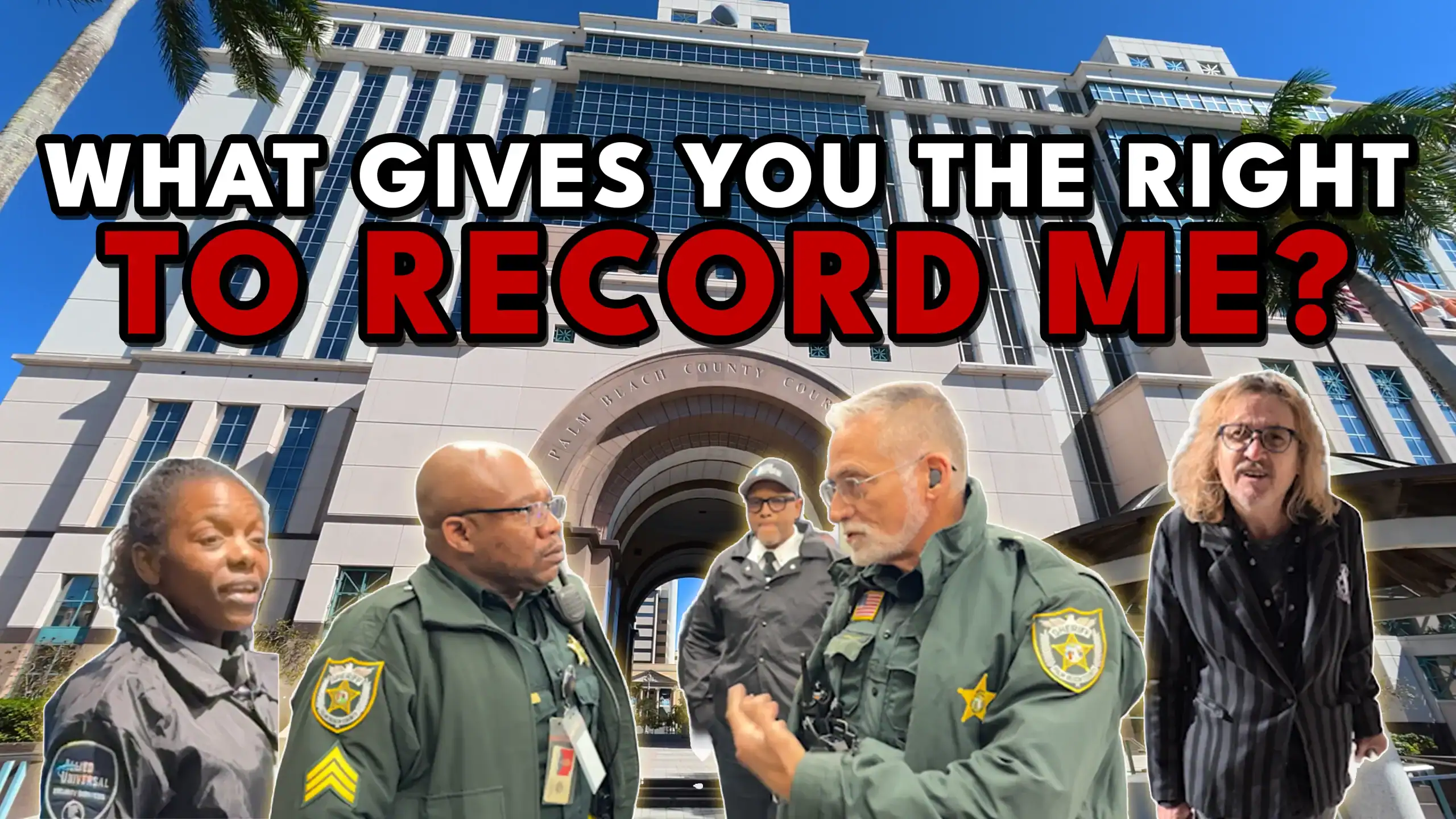
At one point, the question landed directly:
“What gives you the right to record me?”
It’s a powerful question. Not just because of how it was delivered, but because of what it reveals.
The assumption behind it is that rights must be granted by comfort. That permission must be negotiated socially before it exists legally.
But rights don’t work that way.
The right to record in a traditional public forum doesn’t come from approval. It doesn’t depend on tone. And it doesn’t require agreement from the people being recorded.
It comes from the Constitution.
That doesn’t mean every person will understand it in the moment. It doesn’t mean they’ll accept it calmly. And it certainly doesn’t mean the interaction will remain smooth.
But the question itself is worth examining.
Because it reflects a broader cultural tension: the belief that being visible in public should still carry an expectation of control.
It doesn’t.
Public spaces are exactly that — public.
Explaining Preparedness
As the exchange continued, the conversation shifted from filming to personal safety.
At one point, I referenced the fact that I carry tools for self-defense. Not weapons prohibited by the courthouse, but items I keep on me as part of a personal preparedness mindset.
That explanation was not a threat. It was a response to the escalating tone of the conversation. When voices rise and assumptions build, it’s natural to explain where your boundaries are and how you intend to protect yourself if necessary.
Preparedness is often misunderstood.
For some, it sounds aggressive. For others, it’s simply practical. The reality is that being prepared for worst-case scenarios does not mean you are looking to create one.
The distinction matters.
Standing on public steps, exercising a constitutional right, and explaining personal defensive philosophy are not the same as provoking violence. They are separate ideas that sometimes get blurred when emotions are high.
The camera was still rolling. The public forum remained public. The law hadn’t changed.
What changed was the temperature of the conversation.
And that temperature shift is what often defines encounters like this — not legality, but perception.
The Bigger Takeaway
This wasn’t an arrest video.
It wasn’t a dramatic removal from a government building. It wasn’t a viral meltdown.
It was something more common — and arguably more important.
Inside the Palm Beach County Courthouse in West Palm Beach, the tension centered on tone versus legality. Outside on the public steps, it centered on perception versus rights. In between, there was a bride who simply wanted a photograph.
That contrast says a lot.
A camera in a public space can represent different things to different people. To some, it signals transparency and accountability. To others, it feels intrusive or confrontational. The lens itself doesn’t change. The interpretation does.
The interaction inside the courthouse ended professionally. A supervising sergeant clarified the situation. I acknowledged my tone and apologized. No one was detained. No one was trespassed. The law remained intact.
Outside, the conversation became more personal. Questions about privacy and rights surfaced again. The volume rose. The assumptions multiplied. And yet, the legal foundation never shifted.
That’s the reality of public filming.
The law is relatively straightforward. The human response is not.
If there’s anything to take away from this experience, it’s this: rights do not depend on comfort, but accountability does not require hostility either.
Documentation can create tension. It can also create clarity.
On this particular day, it created both.
And none of it was planned.
Disclaimer
The people appearing in my videos are in public spaces where there are no reasonable expectations of privacy. Recording in public is protected by the First Amendment of the United States Constitution. This video is for entertainment and educational purposes only. The legal topics covered on GCNN are designed to be educational and informative. They should never serve as legal advice under any circumstances. The content of this video is in no way intended to provoke, incite, or shock the viewer. This video was created to educate citizens about constitutionally protected activities, law, civilian rights, and emphasize the importance of exorcising your rights in a peaceful manner.